:

  • English
  • Español
  • Italiano
  • Deutsch
  • Nederlands
  • Français
Navigation generated at 2026-2-7 20:50:29
    • All Places to go

      Cities

      • All Cities
      • Aberdeen
      • Dundee
      • Dunfermline
      • Edinburgh
      • Glasgow
      • Inverness
      • Perth
      • Stirling

      Popular Places

      • Ben Nevis
      • Glencoe
      • Loch Lomond
      • Loch Ness

      Towns

      • All Towns
      • Aviemore
      • Dumfries
      • Fort William
      • Kirkwall
      • Lerwick
      • Oban
      • Peebles
      • Pitlochry
      • St Andrews

      Islands

      • All Islands
      • Isle of Arran
      • Isle of Islay
      • Jura
      • Lewis & Harris
      • Mull
      • Orkney
      • Outer Hebrides
      • Shetland
      • Skye

      Regions

      • Aberdeen & Aberdeenshire
      • Argyll & The Isles
      • Ayrshire & Arran
      • Dumfries & Galloway
      • Dundee & Angus
      • Edinburgh & The Lothians
      • Fife
      • Glasgow & Clyde Valley
      • Loch Lomond, Trossachs, Stirling & Forth Valley
      • Highlands
      • Perthshire
      • Scottish Borders
    • All Things to do

      Attractions

      • All Attractions
      • 20 Top Attractions
      • Ancestry
      • Arts & Culture
      • Castles
      • Free Attractions
      • History & Heritage
      • Museums & Galleries
      • Rainy Days
      • TV & Film Locations

      Outdoor Activities

      • All Outdoor Activities
      • Cycling
      • Fishing
      • Golf
      • Horse Riding
      • Mountain Biking
      • Sailing
      • Ski & Snowsports
      • Walking & Hiking
      • Watersports

      Food & Drink

      • All Food & Drink
      • Beer & Breweries
      • Gin Tours & Tastings
      • Whisky & Distilleries

      Landscapes & Nature

      • All Landscapes & Nature
      • Beaches
      • Ben Nevis
      • Lochs
      • National Parks
      • Northern Lights
      • Standing Stones
      • Wildlife Watching

      Tours, Routes & Trails

      • All Tours, Routes & Trails
      • Islands & Island Hopping
      • Itineraries
      • Scotland's UNESCO Trail
      • Tours
      • Walking Trails

      Events

      • All Events
      • Edinburgh's Summer Festivals
      • Highland Games
      • Music Festivals
    • All Accommodation

      Hotels & Lodgings

      • B&Bs & Guesthouses
      • Budget Hotels
      • Hostels
      • Hotels
      • Luxury Hotels
      • Restaurants with Rooms & Inns

      Caravan & Camping

      • All Caravan & Camping
      • Campervan, Motorhome & Caravan Holidays
      • Glamping
      • Wild Camping

      Self Catering

      • All Self Catering
      • Cabins & Lodges
      • Cottages
      • Flats & Apartments
      • Hot Tubs
      • Large Groups

      Unique Places

      • All Unique Places
      • Boats, Barges & Boathouses
      • Brochs & Blackhouses
      • Castles
      • Churches

      Other Accommodation

      • Accessible Accommodation
      • Eco Accommodation
      • Exclusive Use Venues
      • Luxury Accommodation
      • Pet Friendly Accommodation
      • Romantic
      • Wedding Venues
    • All Travel & planning

      Travel to Scotland

      • From England & Wales
      • From Europe
      • From Ireland
      • From North America
      • From Other Continents

      Travel in Scotland

      • Air
      • Bus & Coach
      • Ferry
      • Train

      Driving in Scotland

      • All Driving in Scotland
      • Car Hire
      • Driving Routes
      • Electric Vehicles

      When to visit

      • All When to visit
      • Spring & Easter
      • Summer Breaks
      • Autumn Breaks
      • Winter, Christmas & New Year

      Practical Information

      • Eco-Travel
      • FAQs
      • Holiday Carbon Calculator
      • Passes & Offers
      • Passports & Visas
      • Weather

      Ideas & Advice

      • Outdoor Safety Information
      • Travel Blog
      • Travel Newsletter

      Holiday Types

      • Accessible Holidays
      • Beauty Spots
      • Budget-Friendly Holidays
      • Countryside Breaks
      • Family Holidays
      • Farm Stays
      • Off the Beaten Track Holidays
      • Solo Travel
      • Weekend Breaks
      • Wellness Retreats
  • Map of Scotland

BETA: The search and map are new features with further enhancements planned. VisitScotland is not responsible for the content of external links and accepts no liability for any reliance on these.

Your feedback will help improve the site
  1. Home
  2. Things to do
  3. Landscapes & Nature
  4. Trees you can see in Scotland

Trees you can see in Scotland

Our woodlands, trees and forests are endlessly inspiring. Trees in Scotland offer the chance to lose yourself amongst ancient pines, gain perspective as you wander through towering firs, or learn more about the culture and legends entwined with trees native to Scotland. Read on to discover what trees you can see in Scotland, where to find them and what to look out for. 

Solas Festival in Errol Park

The big hitters

From some of the oldest trees in the UK to some with the most epic legends, there are definitely some top trees to see in Scotland on your adventures. Here are just a few: 

Fortingall Yew

Scotland’s oldest tree 

The oldest tree in Scotland is the Fortingall Yew in Perthshire. It’s actually thought to be one of the oldest trees in Europe, estimated to be between 3,000-9,000 years old! The yew sits in an atmospheric churchyard; the perfect spot to rest and reflect on the deep age of the site and its history. 

See the Fortingall Yew 

The tallest tree in Scotland 

Looming over 65 metres high is Scotland’s tallest tree – a giant Douglas fir in the Reelig Glen. There must be something in the soil in this part of Inverness, as you can spot many of Scotland’s tallest trees in the glen, including the tallest larch and lime trees.  

Explore Reelig Glen 

UK's Tree of the Year 2024

An ancient oak in the Scottish Highlands has been named the UK's Tree of the Year in the Woodland Trust competition! The Skipinnish Oak (named after one of Scotland's famous bands) is thought to be around 400 years old and can be found deep in the Achnacarry Estate in Lochaber.

Learn more about the Skipinnish Oak

The Birnam Oak in spring

Other famous trees 

You’ll find there’s an abundance of trees in Scotland with characterful features, mysterious stories and intriguing legends. Each has its own unique history just waiting to be uncovered.  

  • Pear trees in Jedburgh – these trees were grown by monks in Jedburgh Abbey going back nine centuries, responsible for ‘Jethart pears’ becoming popular across the UK. Their descendants can still be seen in the gardens of Mary Queen of Scots’ Visitor Centre.  
  • The Birnam Oak near Dunkeld – visit the last remaining oak from the ancient Birnam Wood, which plays a key role in Shakespeare’s Macbeth. 
  • Netty’s Tree in the Outer Hebrides – planted by the poet Allan MacDonald, this spruce was for a long time the only tree on the island of Eriskay. It was named after a local crofter who lived next to the tree and encouraged the island’s children to come and practice their climbing on the only tree on the island. 
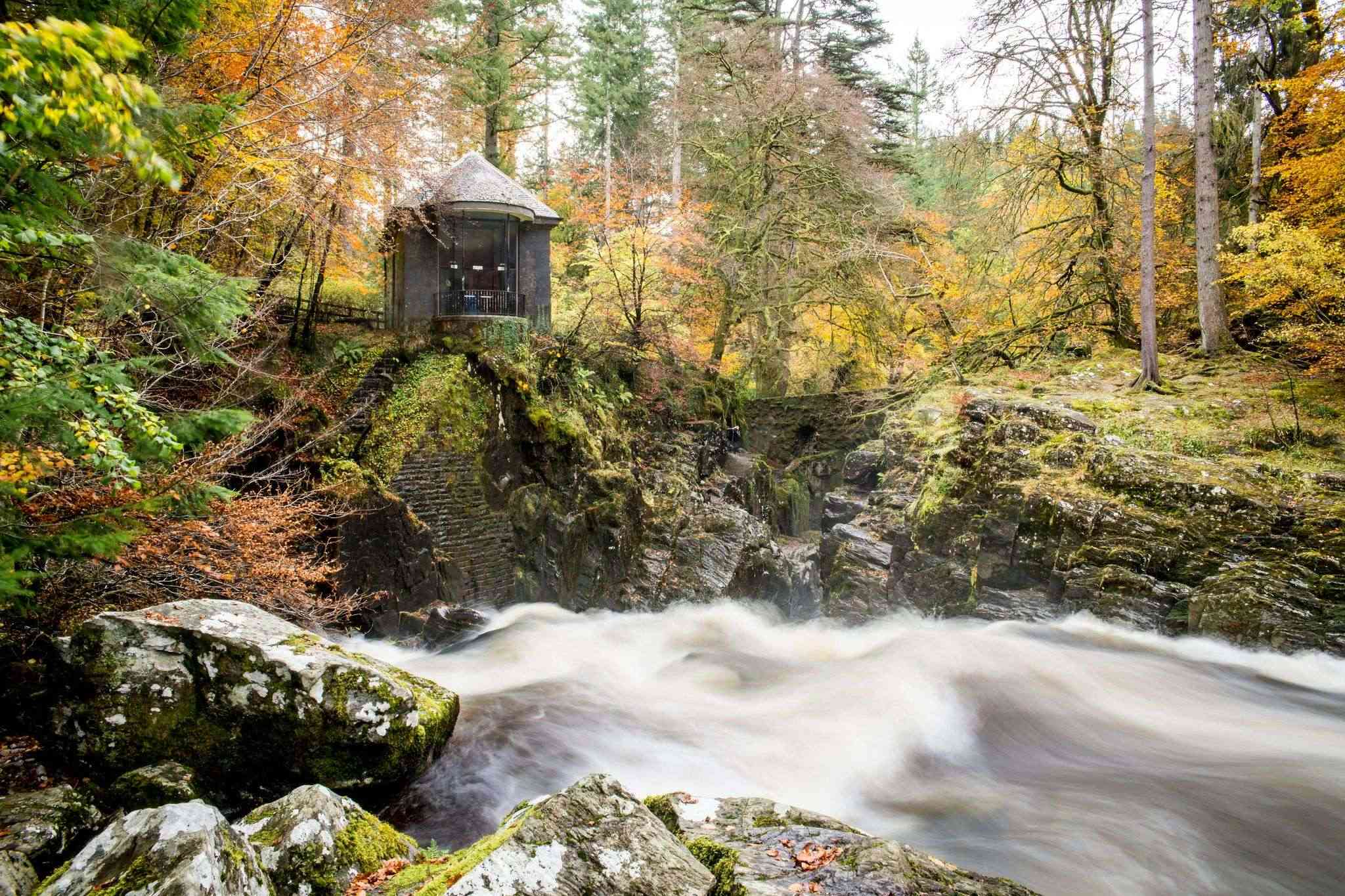
The Hermitage, Dunkeld

  • The Bicycle Tree in the Trossachs – this unusual tree was planted next to the scrap heap of an old blacksmith’s shop. As the tree grew it absorbed the bits and bobs into its trunk, most notably a bicycle from the 1900s which you can still see today! 
  • Big Tree Country – if you want to immerse yourself in the changing colours of autumn, then Perthshire is the place to be. It’s known as ‘Big Tree Country’ with more than 200,000 acres of woodland supporting local wildlife and species.  

Tree species you can see in Scotland

Walking through rowan trees

© VisitScotland / Tessa Minshull

Rowan 

Rowan trees are easily identified by their thin green leaves and bright red clusters of berries. It's also known as mountain ash because it can be found growing at higher altitudes than other Scottish trees, jutting out of nooks and crags in the rock. You’ll be glad to know it’s also easily found all over the country in more accessible spots! It’s particularly beautiful to see in the autumn, when the leaves turn deep red and gold.  

Rowan tree roots reach far back in Scottish culture and folklore, with references throughout Celtic and Gaelic stories. It’s known as ‘Caorunn’ in Gaelic and was traditionally associated with protection against witchcraft, fairies and evil spirits, perhaps because of the five-pointed star shape of its berries. The distinctive berries have a high vitamin C content and have been used for centuries to make jellies, spirits and drinks. (Please do not eat berries off of any plants or trees as they can be toxic to ingest in their raw form). It’s also been used as the clan plant badge of Malcolms and McLachlans – the plant sprig traditionally worn by clan members to distinguish them in battle. You can see rowan trees across Scotland, but the ‘Survivor Rowan’ at the heart of a reforestation project in the Scottish Borders is a special one to visit if you’re in the area.

See the Survivor Rowan 

Learn more on the Forestry and Land Scotland website 

Scots pine wood

© VisitScotland / Tessa Minshull

Scots Pine 

The Scots pine is Scotland’s National Tree, a native species that once swept across vast swathes of the country as part of the ancient Caledonian Pine Forest. The trees themselves are full of character, with strong reddish trunks, blue-green needles and twisting branches. 

As a native species, it's played a significant role throughout Scottish history, from fuelling solstice fires set by druids to being pinned to hats and lapels by the MacGregor clan. The ancient Caledonian forest is equally steeped in mystery and legend - once home to bears, lynx, wild boar and other medieval creatures - but one of the most famous stories about Scots pine originates from the 1600s. A local minister believed Doon Hill in Aberfoyle was the home of the faeries, so when he died people were convinced his spirit was captured by the solitary Scots pine or ‘Fairy Tree’ at the top of the hill. Visiting the site is a great place to see the legendary tree, but you can also still wander parts of the ancient Caledonian forest across certain spots in Scotland, such as near Tyndrum in the Loch Lomond & The Trossachs National Park.  

Walk Doon Hill and the Fairy Knowe route 

Visit the Caledonian Pine Forest 

Learn more with Forestry and Land Scotland   

Silver Birch 

Silver birches are one of Scotland’s most beautiful trees, with peeling silvery bark and dappled leaves. They've existed in the UK since the last ice age, so it’s no surprise they’re strongly associated with the country’s folklore.  

In Celtic mythology, birches are a sign of new life and beginnings, as they’re amongst the first trees to come into leaf in spring. This symbolism made them important in ceremonies and rituals including Samhain and Beltane. Birch twigs were also often used to celebrate St Brigid’s Day – the Celtic goddess of rebirth.  Partly because of how widespread birchwood has historically been throughout the country, it's been utilised in everything from construction and medicine to tanning and whisky making. It’s easy to see silver birch anywhere in Scotland, such as in the birch woods of Craigellachie National Nature Reserve.  

Visit Craigellachie National Nature Reserve 

Learn more with Forestry and Land Scotland  

Wandering through oak trees

© VisitScotland / Tessa Minshull

Oak  

There are few trees as majestic as the oak. Scotland’s native variety is the sessile oak, but we also have plenty of common oak trees in the country. They can live for up to 1,000 years so rank amongst some of Scotland’s oldest and most mythical trees. The broad, strong trunks and small acorns of the tree make oaks easy to identify. 

Oaks have been treated with respect and awe across many cultures and the Celtic druids were no exception; many of their rituals took place amongst oak woods. Its significance remained throughout Scottish history, including the distinction of being the clan badge of the Royal Stewart clan and playing a key role in Shakespeare’s Macbeth. You can still see what’s thought to be the only remaining oak from the ancient Birnam Oak wood mentioned in the play, its twisted branches and gnarled trunk making it easy to imagine it’s seen ancient times. Just don’t be fooled by the ‘Young Pretender’ nearby, which is closer to 300 years old rather than 1,000! 

See the Birnam Oak 

Learn more with Forestry and Land Scotland  

Ash 

Ash is a native tree species in the UK, with full green leaves and light grey bark. Its wood is coveted for furniture making, with its distinctive light colour wood and its hardiness against splintering which make it ideal for tools and handles. 

Known as ‘uinnseann’ in Gaelic, the ash tree has historically been associated with having healing powers and protective properties, thought to ward off evil spirits. It also has strong links to the Vikings; in Norse mythology the Tree of Life was thought to be a great ash tree, which might have influenced how it was viewed in Scotland. Forestry and Land Scotland recommend visiting the Glen Lyon ash tree in Fortingall, Perthshire. Its trunk is over 6 metres wide, and it’s thought to be one of the older ash trees in Scotland at 300-400 years old. Cross another big hitter off your list whilst you’re there and see the Fortingall Yew, the oldest tree in the UK.  

Learn more with Forestry and Land Scotland 

Cherry trees in blossom

© VisitScotland / Tessa Minshull

Wild Cherry 

Native Wild Cherry has a pink hue to its bark and white flowers with green, red and eventually purple berries. It’s also known as ‘gean’ in Scotland, which is thought to be related to the French influence in the country and their word for cherry – ‘guignes’. The deep colour of the wood means it’s often used to make furniture and tools, such as in bagpipe-making or being the traditional wood used for a ‘quaich’ to serve whisky. Other historic uses have been in dying fabrics, food and drink recipes and for certain medical treatments.  

Different parts of Scotland treated wild cherry trees in different ways – in some areas they were associated with witches and not to be touched, but in others they could be grown for warding off spirits. Although the trees are native, they didn’t grow in large numbers so this, combined with their spectacular blossoming in the spring, meant they were usually left untouched. If you miss seeing them in spring, then autumn is also a good time to see wild cherry trees when their leaves turn a fiery orange and red.  

Learn more with Forestry and Land Scotland 

Hazel trees

© VisitScotland / Tessa Minshull

Hazel 

Hazel is often found as a smaller shrub or bush, but they can be left to grow into full trees around 7 metres tall. The tree is easily identified in winter, when catkins appear and dangle from twisted branches. The tree trunks are shiny and smooth but are often covered by lichen and moss.  

Celts associated hazelnuts with wisdom, inspiration and poetry – in Gaelic nut is ‘cno’ and wisdom is ‘cnocach’. The Gaelic word for hazel is ‘coll’ which you can spot in place names around Scotland, such as the Isle of Coll in the Inner Hebrides. Hazel features as the clan badge of the Colquhoun clan. Hazel wood is also a staple of traditional crafts such as basket weaving or fence-building, due to the pliancy of the wood. 

Learn more with Forestry and Land Scotland 

Friends look up at the Douglas firs

© Perth and Kinross Council / Fred Murray / Tessa Minshull

Douglas Fir 

Although not a native Scottish species, the Douglas fir has been a staple in the country since its introduction from America in 1827. It’s named after the Scottish botanist who brought it back to the UK, David Douglas. The evergreen conifers stand straight, with reddish bark, brown cones and deep green needles. One of Scotland’s tallest trees, they can grow up to an impressive 60 metres which makes them ideal for use in timber construction.  

The Douglas fir might not have as deep a connection to Scottish mythology, but with their impressive height they’re a wonder to behold. Dunkeld is one of the best-known spots to see Douglas fir trees, from the cathedral grounds to the Douglas Fir Wood.   

Visit Dunkeld’s Douglas Fir Wood 

Learn more with Forestry and Land Scotland  

Share on

Facebook
Pinterest
WhatsApp
Twitter
Email

Other things you might like

Category: Things to do

Scotland's landscapes, scenery & nature

Category: Things to do

Scottish forests and woodlands

Category: Travel & planning

Slow travel adventures in Scotland

Category: Things to do

Wellness retreats in Scotland

Category: Things to do

Scottish wildlife

Category: Places to go

Countryside breaks in Scotland

Join our Newsletter Clan

Get Scotland inspiration direct to your inbox. Don't miss the inside track from our Scotland experts on exciting trip ideas, unique attractions and hidden gems loved by locals.

Get the Scotland newsletter

Get in touch

  • Contact us
  • Feedback & Complaints
  • Submit an event

Our other sites

  • Business Events
  • Business Support Hub
  • Travel Trade
  • Asset library
  • Corporate
  • Scotland is Now

Find us on

Find us on

  • About us
  • Accessibility
  • Acceptable use
  • Cookies
  • Environmental policy
  • Privacy
  • Social media
  • Terms of use
Brand Scotland

© 2026 VisitScotland. All rights reserved.